The Impact of AI on Game Development: What’s Next?
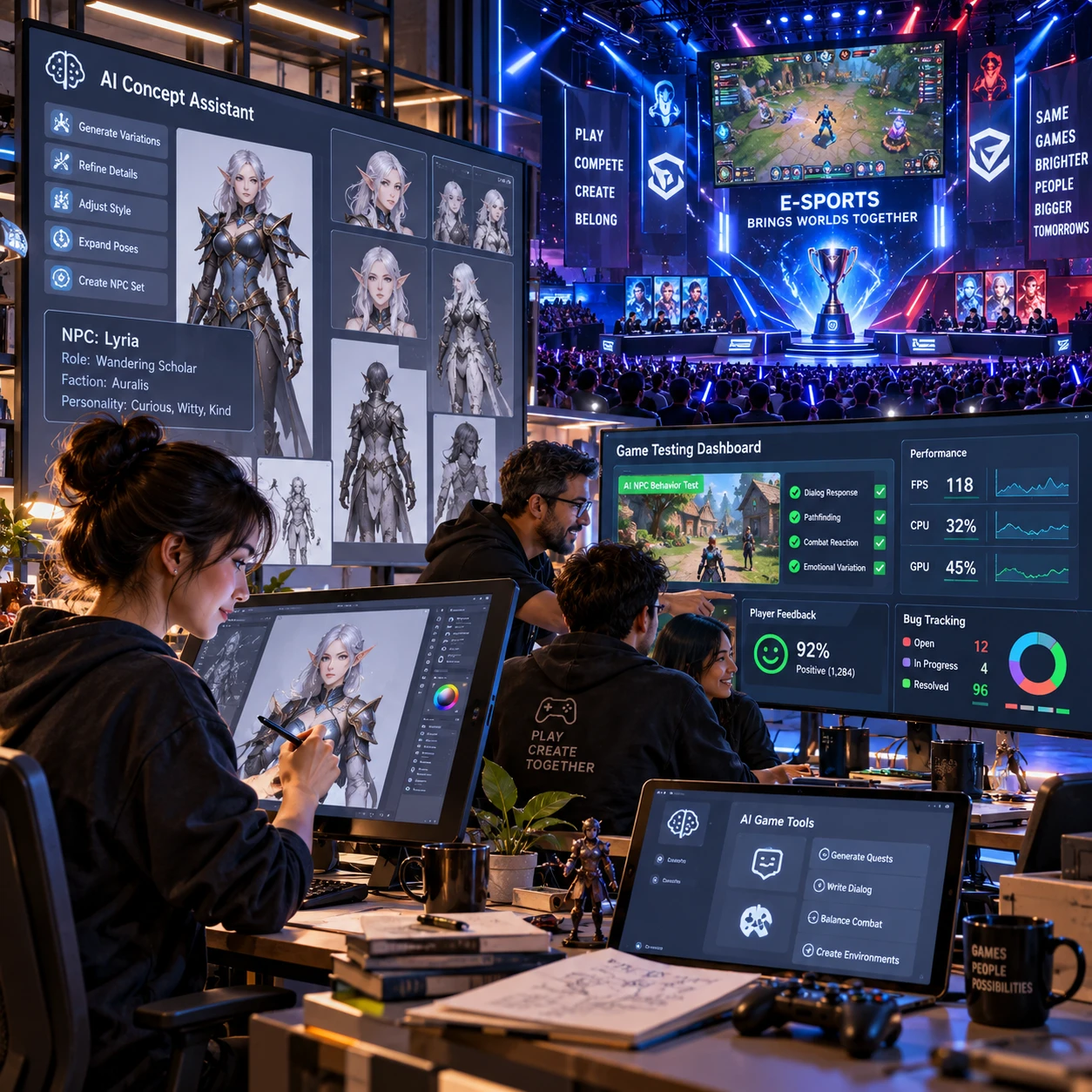
Artificial intelligence is changing how games are designed, built, tested, and maintained. Today, developers use AI to assist with tasks such as generating early concepts, finding software bugs, and analyzing player behavior. The biggest impact may come from how these tools support human teams, rather than replace them.
For players and tournament organizers, the stakes reach beyond production speed. AI could make non-player characters (NPCs) more responsive and help studios update live-service games more effectively. It may also raise harder questions about creative ownership, player data, and competitive fairness.
Where AI Fits in Game Development Today
AI already supports game development in design, production, quality assurance, and live operations. Its role varies by studio, but it is most useful when it speeds up repetitive work while leaving creative and high-stakes decisions to people.
In early game design, generative AI can help teams brainstorm quest variations, dialogue drafts, visual references, or prototype concepts. These outputs give designers material to evaluate and revise; they are not automatically finished game assets. Teams still need to check quality, originality, accessibility, and consistency with the game’s tone.
Production teams can also use machine-learning tools to sort feedback, summarize documents, or help identify patterns in crash reports. In quality assurance and playtesting, automated agents can repeat actions and explore game systems in ways that reveal bugs or edge cases. Meanwhile, analytics tools can help live-service teams understand where players leave a mission or struggle with a feature.
That assistance has limits. AI-generated work can be inaccurate, generic, or difficult to integrate, and reviewing it takes time. A practical rule is to use AI for a defined task with a clear human reviewer, rather than introducing it simply because a tool is available.
Creating More Responsive Game Worlds
AI can make game worlds feel more responsive by helping NPCs react to context, supporting procedural content generation, and enabling developers to tailor some experiences. These systems can add variety, but they still need clear design boundaries.
Traditional NPC behavior often relies on authored dialogue and rules: a character reacts to a specific event or follows a set patrol route. More advanced AI systems may combine those rules with contextual responses, so an NPC can react differently to the player’s actions. Developers must constrain the behavior to preserve the story, tone, and gameplay purpose. Unbounded dialogue generation, for example, can produce lore-breaking or inappropriate responses.
Procedural content generation uses rules or algorithms to create elements such as levels, terrain, item combinations, or encounters. AI can help developers explore more variations, but quantity alone does not make content enjoyable. A generated dungeon still needs a deliberate rhythm, readable navigation, fair encounters, and meaningful rewards.
Adaptive experiences may adjust difficulty or recommendations based on play patterns. This can help a new player learn without making the game feel punishing. However, adaptation should be visible and testable: if an enemy’s behavior or a reward changes, players should not feel that the game is secretly manipulating them. The design goal is a world that feels reactive, not unpredictable for its own sake.
AI in Testing and Live-Service Games
AI can help teams test games by exploring repeated scenarios, detecting anomalies, and organizing player reports. In live-service games, it can also help developers monitor updates and investigate balance issues, though human testing remains essential.
Automated agents can replay a route, try different combinations of abilities, or stress-test a matchmaking flow far more consistently than a person. These tests are useful for catching crashes, broken triggers, and interactions that designers did not anticipate. They do not reliably answer subjective questions such as whether a boss feels fair or a tutorial explains a mechanic clearly.
In a live-service game, teams can use AI-supported analytics to group bug reports, spot unusual changes in match outcomes, or flag a sudden rise in disconnections after an update. That gives developers a faster starting point for investigation. It does not prove what caused the problem, so teams should validate a signal against logs, player reports, and controlled tests before changing the game.
A sensible workflow separates detection from decisions:
- Automate repetition: Run stable tests for common paths, platform configurations, and regression checks.
- Use AI to prioritize: Group similar reports and surface unusual patterns for investigation.
- Keep people in the loop: Have testers judge player experience, severity, and whether a proposed fix creates new problems.
Automation can expand test coverage, but it cannot guarantee a bug-free release. Teams still need human playtesting across different skill levels, hardware, and play styles.
What AI Could Mean for Competitive Games and Tournaments
AI may help competitive games improve matchmaking, monitor balance, and support tournament operations, but it can also create new fairness risks. Any system that affects ranked play or prize-bearing matches needs transparent rules and careful oversight.
Matchmaking systems already use player and match data to find suitable opponents. AI may help identify patterns beyond a simple win-loss record, such as performance across roles or maps. Better matching can make ordinary games more competitive, yet poorly explained rating changes can frustrate players. Developers should give players useful information about ranking rules without exposing details that would make the system easy to exploit.
For balance work, analytics can show that a character, weapon, or strategy appears unusually often or performs well in particular situations. Those signals are clues, not automatic reasons to nerf something. A popular option may be strong because it is fun or easy to learn, while a high win rate may come from skilled players choosing it. Human designers need to test the underlying cause before adjusting the game.
Esports tournaments bring another layer: organizers must protect match integrity. AI-assisted anti-cheat or anomaly detection could help flag suspicious behavior, but false positives can harm legitimate competitors. Tournament rules should specify what evidence is reviewed, who can appeal, and how player data is handled. For high-stakes decisions, automated flags should prompt investigation, not serve as a verdict.
The Risks Developers Need to Manage
The main risks of AI in game development involve creative control, transparency, data use, and changing job responsibilities. Studios can reduce those risks by setting clear policies and involving artists, developers, testers, and players in decisions that affect them.
Creative control can weaken when teams accept generated dialogue, art, or design ideas without review. AI can produce plausible material quickly, but plausible is not the same as distinctive. A studio should decide which work must remain human-authored and document how generated material is reviewed before it enters a release.
Data practices matter too. Tools trained or operated on player data may raise privacy and consent concerns, especially if data is collected beyond what a feature needs. Developers should limit collection, protect sensitive information, and explain relevant uses in accessible language.
Workforce changes deserve an honest conversation. AI may reduce some repetitive tasks, while increasing demand for people who can evaluate outputs, build reliable pipelines, or test complex systems. That shift can still unsettle workers, particularly if expectations change without training or consultation. Studios should assess tools by their effect on job quality and team capacity, not only by the number of tasks automated.
Common mistakes include treating generated content as production-ready, trusting analytics without checking context, and using automated suspicion as proof of cheating. In each case, the correction is similar: define the system’s limits, require human review, and provide a way to challenge consequential decisions.
What’s Next for AI in Game Development?
The next phase of AI in game development is likely to be practical and uneven: more assistance in prototyping, testing, content workflows, and live operations, with human teams deciding what reaches players. Adoption will depend on whether tools improve a specific workflow without damaging trust or creative quality.
Studios can assess a proposed tool with three questions: Does it solve a real production problem? Can the team verify its output? Would players or competitors be affected if it made a mistake? A tool that helps organize internal bug reports has a different risk profile from one that changes ranked matchmaking or generates dialogue in a story-driven game.
For players, the most noticeable changes may be subtler NPC reactions, more varied environments, and updates informed by better analysis. For developers, AI may free time for iteration, but only when the cost of checking and integrating outputs is lower than the time saved. For esports communities, confidence will hinge on clear rules and accountable decisions.
AI is likely to become another part of the development toolkit, not a substitute for game direction, skilled craft, or playtesting. The studios best positioned to use it well will choose specific problems, test tools against real player needs, and keep people responsible for the final call.