The Evolution of Online Multiplayer Games: From MUDs to Metaverses
Few technologies have changed how humans play — and socialize — as dramatically as online multiplayer gaming. What started as lines of text scrolling across a university terminal in the late 1970s has grown into persistent virtual worlds with hundreds of millions of active players. The journey from Multi-User Dungeons to immersive metaverse platforms isn't just a story about hardware and bandwidth. It's a story about why people keep showing up, logging in, and finding each other in digital spaces.
Where It All Began — Text-Based Worlds and MUDs (1970s–1980s)
Online multiplayer gaming began with MUDs — text-based virtual environments where players typed commands to explore dungeons, fight monsters, and interact with strangers in real time. The first widely recognized MUD was created by Roy Trubshaw and Richard Bartle at the University of Essex in 1978, running on ARPANET-connected systems before the public internet existed.
What made MUDs remarkable wasn't the technology — it was the social architecture underneath. Players formed alliances, developed reputations, and built entire communities around shared fictional spaces. The dungeon master model gave way to player-driven storytelling, and for the first time, the game world felt genuinely alive because other humans were in it.
By the mid-1980s, dozens of MUD variants existed across university networks. Some leaned toward combat and progression; others focused on roleplay and world-building. The distinction between game and social platform was already blurring — a tension that would define multiplayer gaming for the next five decades.
The Rise of Graphical Online Worlds (1990s)
The 1990s transformed online multiplayer by adding visuals, replacing typed commands with point-and-click interfaces and sprite-based avatars. Early internet infrastructure — dial-up modems, bulletin board systems, and eventually commercial ISPs — made it possible for players outside universities to connect for the first time.
LAN gaming became a cultural phenomenon in this era. Local area network parties, where players hauled desktop towers to a shared location, created a distinct social ritual around competitive play. Games like Quake and StarCraft built competitive communities that would later seed the esports industry.
Toward the late 1990s, the first graphical MMORPGs arrived. Titles like Ultima Online (1997) and EverQuest (1999) offered persistent worlds where thousands of players coexisted simultaneously. These weren't just games — they were places. Players spent hundreds of hours building characters, joining guilds, and forming friendships that extended well beyond the screen.

The shift from text to graphics lowered the barrier to entry significantly. You no longer needed to imagine the world — it was rendered for you. That accessibility brought in a much broader audience and set the stage for what came next.
The MMORPG Golden Age and the Broadband Revolution (2000s)
The 2000s were the golden age of MMORPGs, powered by a single infrastructure shift: the widespread adoption of broadband connectivity. Faster, always-on internet connections made the latency and instability of dial-up obsolete, and suddenly massive persistent worlds became genuinely playable for mainstream audiences.
The scale of what became possible was staggering. Persistent worlds now supported raids requiring coordinated groups of 40 or more players. Player communities organized themselves into guilds with hierarchies, rules, and long-term goals. Some guilds operated more like small organizations than casual gaming groups — scheduling sessions, managing rosters, and developing reputations that spread across entire server communities.
This era also cemented multiplayer gaming as mainstream entertainment, not a niche hobby. The social layer was no longer secondary to the gameplay — for many players, the relationships and community were the primary reason to log in. That insight would prove enormously influential for every multiplayer design that followed.
Social Gaming, Consoles, and the Multiplayer Explosion (2010s)
The 2010s democratized online multiplayer by moving it onto consoles, smartphones, and social platforms simultaneously. Console online networks gave living-room players seamless access to competitive and cooperative multiplayer without needing a gaming PC, while mobile gaming brought casual multiplayer to billions of people who had never considered themselves gamers.
This decade also introduced cross-platform multiplayer as a serious conversation. For years, players on different hardware ecosystems couldn't share the same game world. Gradually, that wall began to crack, and titles that enabled cross-play between console and PC audiences saw dramatic spikes in active player counts.
Social features became deeply embedded in game design. Friend lists, voice chat, spectator modes, and clip-sharing tools transformed games into social hubs. The line between playing a game and watching someone else play it dissolved — streaming platforms turned skilled players into entertainers with audiences in the millions, creating an entirely new layer of community around multiplayer games.
Battle Royales, Live Services, and the Era of Ongoing Worlds
The battle royale genre and the live service model together reshaped how players relate to multiplayer games over time. Rather than a fixed product you finish and shelve, live service games are designed to evolve continuously — new content, seasonal events, and balance updates keep the experience fresh for years after launch.
The battle royale format itself was a design breakthrough. Dropping 100 players onto a shrinking map created a natural tension arc that felt different every match, with no two games playing identically. The format's accessibility — free-to-play entry points, short session lengths, and spectator-friendly gameplay — helped it reach audiences far beyond traditional gaming demographics.
Live service design introduced a new kind of player engagement: the seasonal calendar. Limited-time events, battle passes, and rotating playlists gave players reasons to return on a schedule, building habitual engagement patterns that traditional game releases couldn't sustain. The trade-off is real, though — this model demands ongoing time investment, and players who step away for a few months can return to find the game substantially changed, or their progress relatively diminished.
Player communities adapted to this rhythm. Clans and competitive teams built around live service titles developed long-term strategies around seasonal resets, content drops, and meta shifts — treating the game less like a product and more like a living sport.
Stepping Into the Metaverse — VR, AR, and the Next Frontier
The metaverse, in gaming terms, refers to persistent, interconnected virtual spaces where players don't just play games but inhabit shared digital environments — socializing, creating, trading, and experiencing events together across platforms. It's less a single product and more an emerging direction for what online worlds could become.
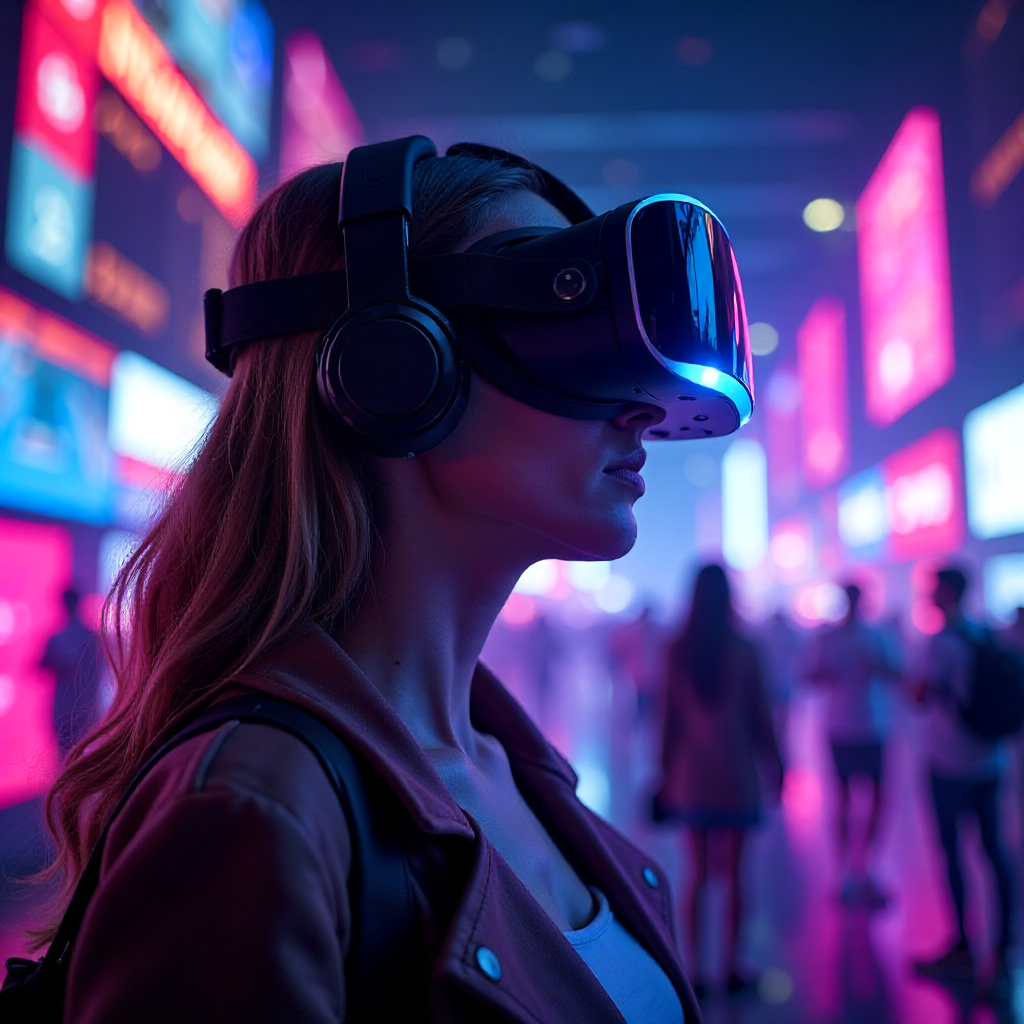
Virtual reality and augmented reality are the most visible technologies pushing this direction forward. VR headsets allow players to be physically present in a game space — turning their head to look around, using hand controllers to interact with objects, and perceiving scale and depth in ways a flat screen can't replicate. AR layers digital elements onto the physical world, creating hybrid experiences that blur the boundary between the game and the player's real environment.
The metaverse concept draws directly from the lineage of MUDs and MMORPGs — persistent spaces, social identity, player-driven economies — but scales those ideas with modern hardware and connectivity. The challenges are significant: hardware costs remain high for full VR immersion, standardized cross-platform identity is technically and commercially complex, and building genuinely compelling social experiences in virtual space is harder than it looks.
Still, the direction is clear. Online multiplayer is moving toward spaces that feel less like games you play and more like places you go. Whether that transition takes five years or twenty depends on infrastructure, hardware adoption, and — most importantly — whether players find those spaces worth inhabiting.
What Stays the Same — Community, Competition, and Connection
Across every era of online multiplayer gaming, the core human motivations have remained constant. Players keep coming back for competition, collaboration, and the feeling of belonging to something larger than a solo experience.
A player in a 1980s MUD guild and a player in a 2024 live service clan are doing fundamentally the same thing: finding their people, building shared history, and measuring themselves against others. The technology changes. The social architecture underneath it barely does.
This is worth remembering when evaluating what's next. Metaverse platforms and VR environments will succeed or fail not primarily because of their technical specifications, but because of whether they give players meaningful ways to connect. Every era of multiplayer gaming that captured a generation did so by solving that problem well — from typed commands in a university dungeon to a hundred players parachuting onto an island together.
The medium keeps evolving. The reason people play hasn't changed at all.
Frequently Asked Questions
What was the first online multiplayer game?
The first widely recognized online multiplayer game is MUD1, created by Roy Trubshaw and Richard Bartle at the University of Essex in 1978. It ran on ARPANET and allowed multiple players to explore a shared text-based world simultaneously. Some earlier experimental networked games existed in academic settings, but MUD1 is generally credited as the origin point of the multiplayer gaming tradition. You can read more about its history via Wikipedia's MUD1 entry.
What is the difference between an MMO and a metaverse?
An MMO (Massively Multiplayer Online game) is a specific game with defined rules, objectives, and a contained world. A metaverse is a broader concept — a persistent virtual environment where players can socialize, create content, participate in economies, and move between different experiences, not just one game. Think of an MMO as a destination; the metaverse is more like a city with many destinations inside it.
How has internet speed changed online gaming?
Internet speed has been the single biggest infrastructure factor in multiplayer gaming's evolution. Dial-up connections in the 1990s limited what was technically possible — lag made fast-paced games nearly unplayable at scale. The broadband revolution of the early 2000s unlocked MMORPGs, competitive shooters, and persistent worlds with thousands of simultaneous players. Today, low-latency fiber and 5G connections are enabling cloud gaming and laying groundwork for more immersive VR multiplayer experiences.
Are MUDs still played today?
Yes, MUDs still have active communities. Several original and derivative MUDs remain online and maintain dedicated player bases, particularly in roleplay-focused communities that value the depth of text-based interaction over graphics. The MUD genre also influenced the design of modern MMORPGs, interactive fiction, and even some indie games that deliberately return to text-based mechanics.
What does "live service game" mean?
A live service game is a multiplayer title designed to be updated and expanded continuously after launch, rather than released as a finished product. These games typically use seasonal content cycles, battle passes, and regular patches to keep players engaged over months or years. The model generates ongoing revenue and sustains player communities long-term, but it also means the game you play at launch may look quite different two years later.